

The Agency’s Guisde to Building a Scalable SEO Reseller Model
Sep 28, 2026
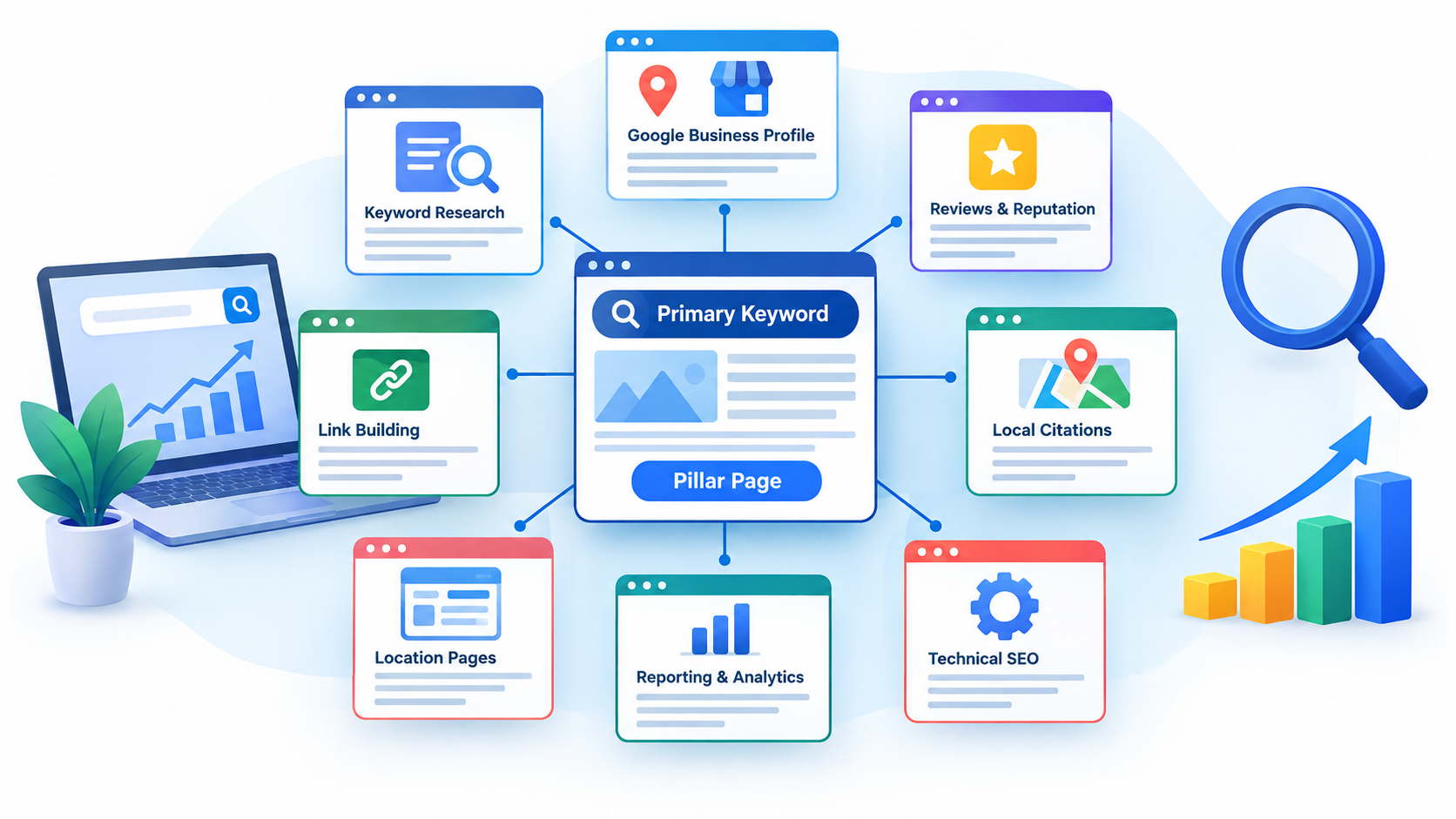
A single keyword can open the door to an entire content strategy. Instead of creating one page around a primary search term and moving on, you can use that keyword as the foundation for a broader topic cluster. This approach helps you cover related search intent, strengthen topical relevance, build internal links, and create useful resources that search engines and AI-powered platforms can understand more easily.
For agencies managing multiple clients, this strategy also makes SEO campaigns more scalable. A Pro SEO Reseller can transform one valuable keyword into a structured network of content that supports visibility across traditional search and generative search experiences.
A topic cluster is a group of closely related content pieces organized around one central subject.
The structure generally includes:
For example, suppose the primary keyword is “local SEO.” Instead of publishing one article, you could build a cluster around Google Business Profile optimization, local citations, local keyword research, reviews, location pages, local link building, and local SEO reporting.
Each page serves a different search intent while reinforcing the overall topic.
The first step is understanding what users actually want when they search for your target keyword.
Look beyond the exact phrase and identify different intent types:
Informational intent: Users want explanations, definitions, guides, or answers.
Commercial intent: Users are comparing solutions, services, or providers.
Transactional intent: Users are ready to take an action, such as requesting a quote or purchasing a service.
Navigational intent: Users are looking for a specific company, website, tool, or resource.
A strong cluster addresses several relevant intents rather than forcing every page to target the same keyword.
Once you understand the core intent, identify questions and concepts naturally connected to the keyword.
For a keyword such as “SEO reseller,” supporting topics could include:
Do not create pages simply because a keyword tool produces hundreds of variations. Each piece should have a distinct purpose and provide information that deserves its own page.
Modern search is not limited to matching exact keywords. Search systems increasingly evaluate relationships between concepts, entities, questions, and supporting information.
That means your cluster should naturally include relevant terminology and concepts.
For an SEO topic, this might include technical SEO, backlinks, crawlability, structured data, content optimization, search intent, entities, topical authority, analytics, and conversions.
The goal is not keyword stuffing. The goal is complete topical coverage.
When related concepts are explained accurately and connected logically, your website becomes a stronger resource for both search engines and AI-driven discovery systems.
Internal links connect the cluster together.
Your pillar page should link to important supporting pages, while cluster pages should link back to the pillar when relevant. Supporting articles can also link to one another when there is a genuine contextual relationship.
Use descriptive anchor text rather than generic phrases such as “click here.”
For example, an article about SEO outsourcing could naturally link to a resource about white-label SEO services. This gives readers and search systems additional context about the destination page.
Avoid creating artificial links just to increase the number of internal links. Every connection should help users discover relevant information.
Generative search systems need clear, trustworthy, and easily interpretable information.
Make each page useful as a standalone answer. Use descriptive headings, concise definitions, logical sections, examples, statistics where appropriate, and direct answers to common questions.
Include unique insights instead of rewriting information that already exists everywhere.
You can also strengthen content by clearly demonstrating expertise through practical processes, original observations, examples, and transparent explanations.
A well-organized cluster gives AI systems multiple contextually connected resources to understand your expertise on a subject.
Do not judge a topic cluster only by the ranking of its primary keyword.
Track:
This broader measurement approach can reveal opportunities that a single-keyword report misses.
Creating topic clusters consistently requires research, content planning, optimization, internal linking, and ongoing measurement. Agencies serving multiple clients may struggle to maintain this process at scale.
Working with a Pro SEO Reseller can help agencies turn repeatable SEO processes into scalable campaigns while maintaining a consistent strategy across client accounts.
The most effective approach is to treat every valuable keyword as a potential content ecosystem—not simply an isolated ranking target.
A keyword topic cluster is a group of interconnected pages built around a central topic. A main pillar page covers the broad subject, while supporting pages address related questions and subtopics.
There is no fixed number. Build as many pages as needed to cover meaningful subtopics and search intents without creating thin or repetitive content.
Ideally, each page should have a distinct primary intent or topic. Related keyword variations can be included naturally, but creating multiple pages with the same intent can cause unnecessary overlap.
Topic clusters help organize information, improve internal linking, expand search coverage, and demonstrate comprehensive topical knowledge.
They can support AI-search visibility by creating clear, interconnected resources that provide comprehensive information about a subject. However, no content structure can guarantee inclusion in AI-generated answers.
Yes. Agencies can develop repeatable research, content, linking, optimization, and reporting workflows. A reliable Pro SEO Reseller can also support agencies that need additional capacity for multiple campaigns.
A high-value keyword should not be treated as a single-page opportunity. By mapping its search intent, related questions, entities, and subtopics, you can build a connected content ecosystem that serves users at different stages of the journey.